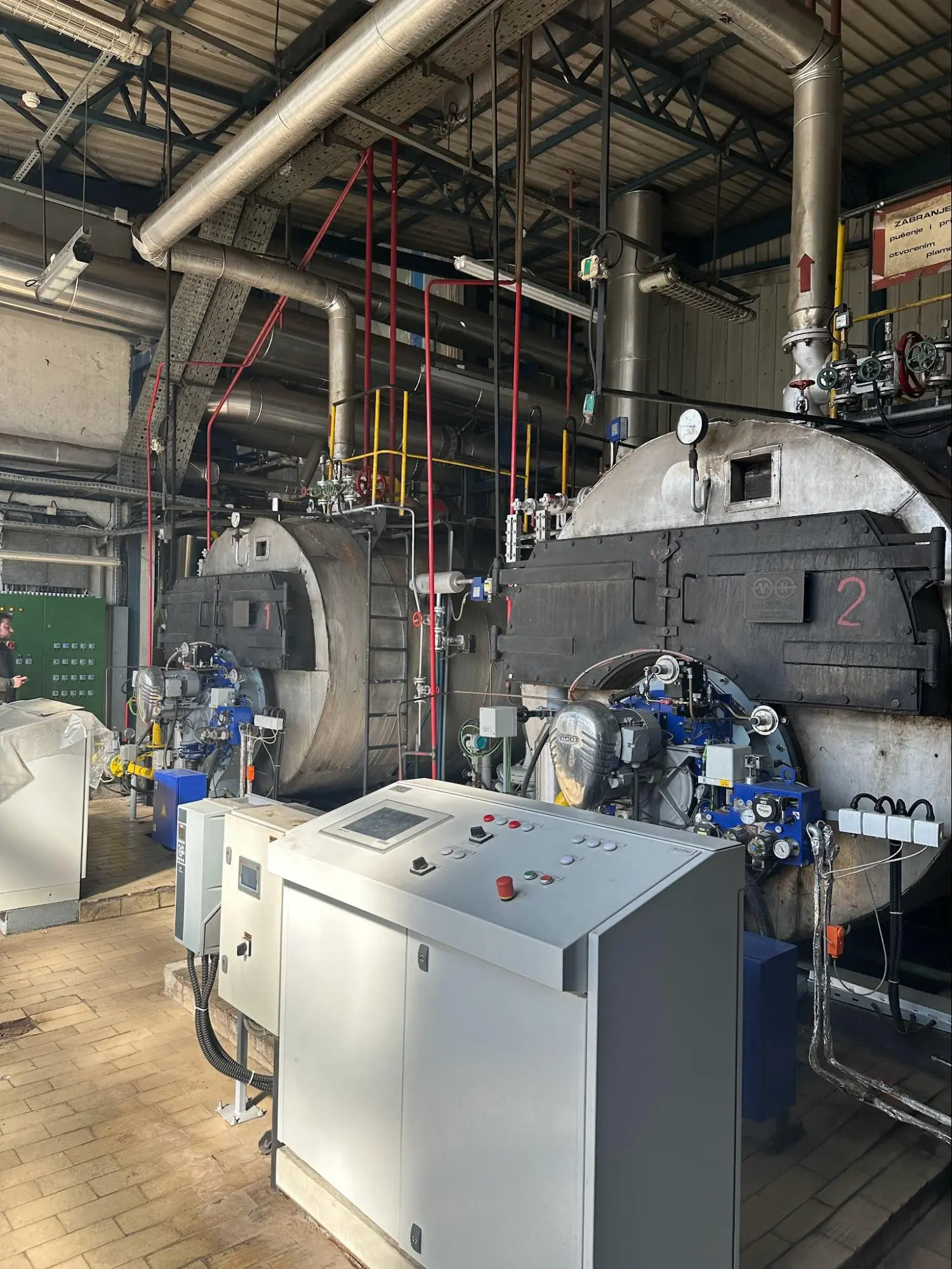
The Problem Nobody Talks About
Every plant manager, energy director, and chief engineer knows what it feels like when the boiler room becomes a liability.
Unplanned shutdowns. Rising fuel bills that don't match your output. An inspector who's starting to ask uncomfortable questions about your NOx levels. Or simply the knowledge that the equipment keeping your facility running was installed before some of your engineers were born.
The decision to modernize is rarely the hard part. The execution is.
And the uncomfortable reality — one we've seen play out across several decades — is that most boiler modernization projects don't fail because of bad equipment. They fail because of how they're structured.
The Fragmentation Problem
Here is the typical project structure in this industry:
An engineering consultancy designs the solution. A separate equipment supplier delivers the boilers and burners. A third-party contractor handles civil and mechanical installation. A controls integrator commissions the automation. And if something goes wrong — which it will, because something always does — the first conversation is about whose scope it falls under.
Nobody is lying. Nobody is incompetent. But nobody is fully accountable either.
When the boiler efficiency underperforms post-commissioning, the equipment supplier points to the installation. The installer points to the design spec. The designer points to the operating conditions that weren't in the brief. Meanwhile, your facility is running at 84% efficiency when it was promised 94%, and your energy manager is writing variance reports instead of fixing the problem.
This is contractor fragmentation. It is the single most common cause of industrial boiler modernization projects that deliver less than expected — and it is entirely structural.
What a Vertically Integrated Approach Changes
There is a different way to run these projects. It requires one company to hold the entire scope — from initial thermal calculations and system design through to equipment manufacturing, site installation, commissioning, and long-term maintenance.
When a single team is responsible for every phase, several things change fundamentally:
Engineering is accountable to the outcome, not just the specification.
The design engineer knows they'll be on-site during installation. The installer knows they'll be called if the system underperforms in year two. Decisions made during engineering have direct consequences for the people making them. That changes how conservative — or creative — those decisions are.
Interfaces between disciplines disappear.
In fragmented projects, the gaps between contractors are where problems live: the flue gas connection that wasn't coordinated, the control logic that didn't account for the actual flow characteristics, the pipe routing that made future maintenance access impossible. When one team does it all, these interfaces are internal conversations, not contractual disputes.
Lead times compress.
When engineering, manufacturing, and logistics are coordinated internally, critical-path items don't wait for purchase orders between companies. Custom components get prioritized because the people manufacturing them are working toward the same project deadline.
Maintenance is informed by the people who built it.
This is underrated. A maintenance team that inherited a system they didn't build is working from documentation. A maintenance team that designed, manufactured, and commissioned the system is working from memory and direct knowledge. The difference in response time and diagnostic accuracy is significant.
Who This Matters For
Not every boiler project has the same risk profile. A straightforward like-for-like burner replacement on a standard hot water boiler in a well-documented installation is a different undertaking from a full boiler house reconstruction at an operating refinery or a district heating plant that cannot be taken offline during heating season.
The larger the project, the more complex the fuel mix, the more critical the uptime requirement — the more the fragmentation model costs you. This is where vertical integration stops being a marketing claim and becomes a measurable operational advantage.
In our experience, the projects where fragmentation causes the most damage are:
- Full boiler house reconstructions, where the interface between civil, mechanical, and electrical scopes is dense
- Fuel conversion projects — switching from heavy fuel oil to gas, or integrating biomass alongside fossil fuels — where combustion engineering, burner selection, and controls must be co-designed
- Emissions compliance upgrades, where the NOx reduction target has to be engineered, not approximated, and verified post-commissioning
- Installations in operating facilities, where downtime windows are short and sequencing must be precise
What We Do — And What We Don't
MIK Projekt designs, engineers, manufactures, installs, and maintains industrial boiler houses. Our roots trace back all the way back to the year of 1931. Our installed base spans across 10 countries, with an aggregate installed capacity exceeding 10,000 MW.
We are not a product catalogue. We do not sell standard boilers off a shelf and hand the project to an installer. Every project starts with engineering. Every boiler we deliver is built in our own production facility. Every installation is executed by our team. Every system we put into operation, we can maintain — because we built it.
We work across all major fuel types: natural gas, oil, biomass, coal, waste materials, and multi-fuel configurations. We work across sectors: district heating, thermal power, food and beverage, chemical and petrochemical, pharmaceutical, pulp and paper, and large institutional facilities.
The one thing we do not do is walk away after commissioning and leave you with a warranty document and a phone number.
A Note on Realistic Expectations
Vertical integration does not make projects frictionless. Complex industrial work is inherently difficult. Schedules get compressed, site conditions differ from drawings, and fuel quality varies.
What vertical integration does is ensure that when those things happen — and they will — there is one team responsible for resolving them. Not a chain of emails between contractors arguing about scope. One call. One accountable party. One team that already knows your system.
That is what we mean when we say turnkey. Not a marketing term. An operational structure.
If Your Boiler Room Is Becoming a Problem
Most facilities reach out to us when something has already gone wrong — a failed inspection, an unplanned shutdown, an energy audit that produced uncomfortable numbers, or a previous contractor relationship that didn't deliver.
Some reach out earlier, because a chief engineer who has seen one poorly structured modernization project does not want to repeat the experience.
Either way, the starting point is the same: understanding your system, your constraints, and what outcome you actually need.
If that conversation is relevant to where you are right now, you know where to find us.