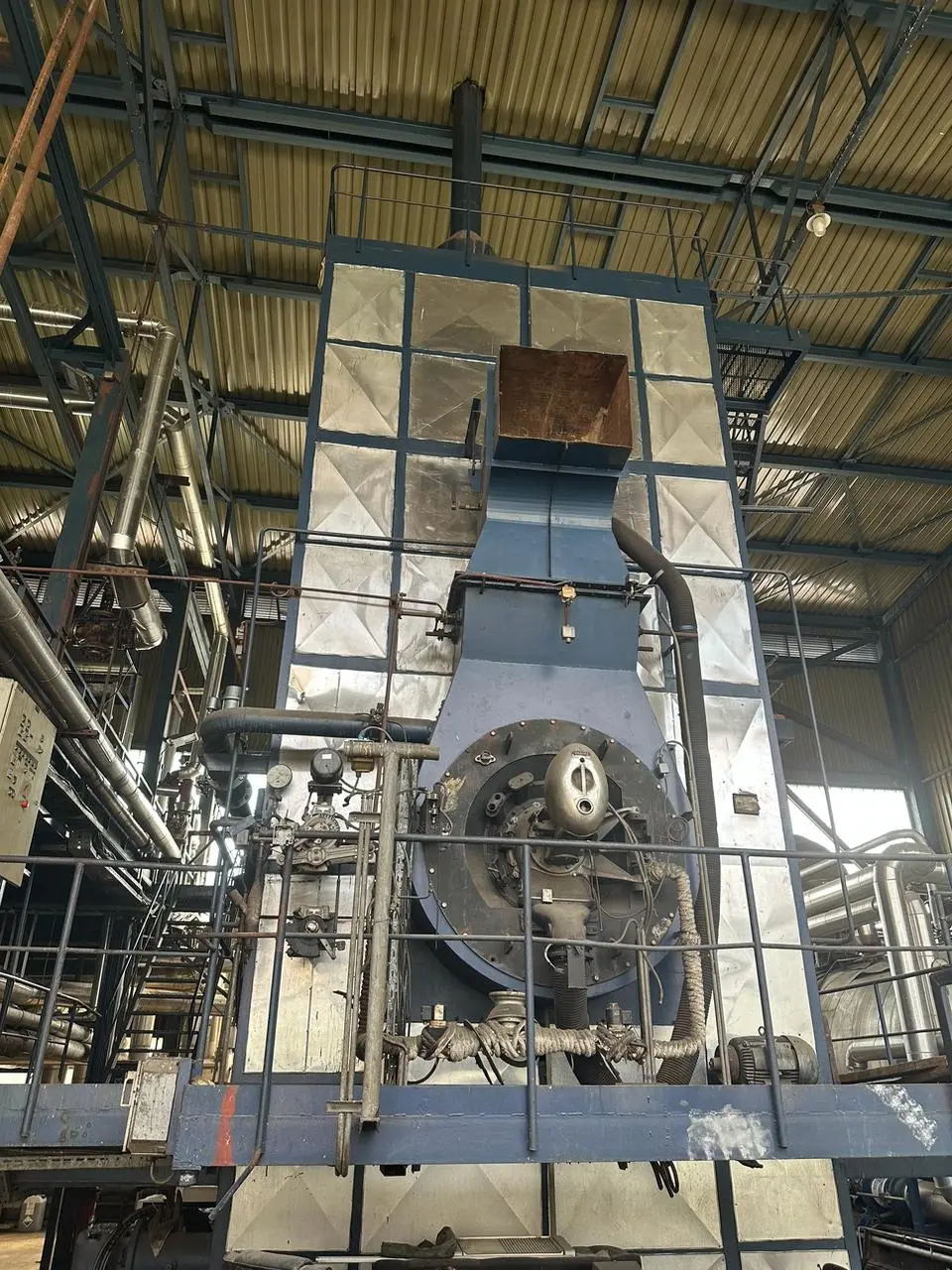
Most industrial boiler replacements are not planned. They are triggered — by an unscheduled shutdown, a failed inspection, a maintenance bill that finally exceeded the cost of a new unit. By the time the decision is made, the pressure to move fast is real, and fast decisions in this domain are expensive ones.
This guide is written for the engineer or plant manager who wants to get ahead of that scenario. Whether you are managing a steam boiler approaching the end of its design life, a hot-water system that no longer meets your process load, or a unit that cannot comply with current NOx emission limits, the replacement process follows the same structured sequence. Skipping or compressing any stage is where projects go over budget, over schedule, or both.
Key fact
Industrial boilers have a design life of 20 to 30 years. Deferred maintenance can cut that by 30 to 50%. A boiler that should last 25 years may need replacement at 15 if it has not been serviced correctly.
What follows is a practical walkthrough of that process — from the initial technical audit through final commissioning — with the failure points called out at each stage.
Step 1: Technical Audit and Condition Assessment
Before any specification is written or vendor contacted, you need an honest picture of what you have. A technical audit covers the current boiler's mechanical condition, combustion performance, and compliance status against applicable standards (EN 12952 for water-tube boilers, EN 12953 for shell boilers, and the Pressure Equipment Directive (PED 2014/68/EU) for CE-marked equipment).
What the audit should cover
- Pressure parts integrity: wall thickness measurements, corrosion mapping, weld inspection records
- Combustion efficiency: flue gas analysis, excess air ratio, CO and NOx measurements at current operating load
- Heat transfer surfaces: fouling, scaling, tube condition (internal and external)
- Burner and control system: age, parts availability, BMS compliance with current safety standards (EN 746, EN 267/EN 676)
- Ancillary systems: feed water treatment, pumps, valves, instrumentation — these are often overlooked and add cost later
The common failure at this stage
The audit is abbreviated or skipped entirely when a project is already in motion. The result is a specification built on assumptions. Undersized replacement units, incompatible fuel systems, and foundation surprises during demolition are almost always traceable to an incomplete audit.
A thorough audit typically takes 3 to 5 days on-site and pays for itself many times over in avoided rework.
Step 2: Define the Replacement Scope and Build the Business Case
The audit results answer the technical question: replace or retrofit? The answer determines the project scope, and the scope determines what you bring to management for approval.
Replace vs. retrofit: the decision framework
| Scenario | Recommended path |
|---|---|
| Boiler body in acceptable condition, burner obsolete | Burner retrofit only |
| Pressure parts degraded beyond economic repair | Full boiler replacement |
| Process load has increased beyond rated capacity | Full replacement, upsized |
| NOx limits cannot be met with existing burner | Burner retrofit with low-NOx combustion system |
| Boiler body and burner both at end of life | Full EPC replacement |
Building the internal business case
This is where most engineering projects stall. The technical case is clear; the financial justification is not prepared. A replacement project needs three numbers to move through approval:
- Current operating cost baseline — 12 to 24 months of fuel and maintenance spend, with reactive maintenance separated from planned preventive maintenance. High reactive spend is the strongest argument for replacement.
- Projected energy savings — a modern industrial boiler operating at 88 to 92% thermal efficiency versus an aging unit at 78 to 82% represents a 6 to 14 percentage point improvement. On a facility running 6,000 hours per year, that difference is measurable in tens of thousands of euros annually.
- Cost of failure — for boilers past 20 years of age, model the cost of an unplanned mid-season failure: emergency service premiums, production downtime, and temporary heat supply. According to U.S. Department of Energy data, the avoided cost of a single unplanned failure often justifies the replacement investment on its own.
The payback reality
A modern high-efficiency industrial boiler replacement typically achieves a 3 to 7 year payback through fuel savings of 15 to 30%, depending on operating hours and baseline efficiency.
Step 3: Technical Specification and Vendor Selection
With the scope approved, the next step is a technical specification detailed enough to get comparable offers and to hold a contractor to account during execution.
What a complete boiler replacement specification includes
- Thermal and process parameters: rated output (MW or t/h steam), operating pressure (bar), supply and return temperatures, minimum and maximum load range
- Fuel type and flexibility: current fuel, any future transition requirements (e.g., biomass co-firing, hydrogen-blend readiness)
- Emission limits: NOx, CO, and particulate limits to comply with local environmental permits and applicable EU Industrial Emissions Directive (IED) thresholds
- Applicable standards: EN 12952 or EN 12953, PED CE marking requirements, BMS standard (EN 746-2 or equivalent)
- Site constraints: boiler house dimensions, existing foundation loads, access routes for equipment delivery, chimney height and cross-section
- Scope of supply: whether the contractor is responsible for engineering only, supply only, or full EPC (engineering, procurement, construction, commissioning)
Evaluating vendors
A technically literate buyer evaluates vendors on four criteria, in this order:
- References in comparable applications — same boiler type, similar capacity, same sector. Ask for contact details and verify them.
- Manufacturing capability and certifications — PED-compliant manufacturing, EN ISO 3834-2 welding certification, and documented quality management.
- Scope coverage — can the vendor handle the full EPC scope, or will you be managing multiple sub-contractors?
- Service and spare parts commitment — a boiler is a 20 to 25 year asset. The vendor's ability to service it over that period matters more than the initial price.
The lowest-price offer is rarely the lowest total cost of ownership. A unit that arrives without CE documentation, or an installer without PED experience, creates compliance problems that are expensive to resolve after the fact.
Step 4: Engineering Design and Project Planning
Once a contractor is selected, the engineering phase begins. This is where the replacement is designed in detail, and where the decisions made here determine whether installation runs smoothly or not.
Key engineering deliverables
- 3D layout and clash detection — particularly important in constrained boiler houses where existing pipework, structural steel, and access routes limit what can be installed without modification
- Hydraulic and thermal calculations — confirming the new unit integrates with the existing distribution system without requiring full pipework replacement
- Foundation and structural assessment — the new boiler may have a different footprint, weight, or vibration profile than the unit being removed
- Combustion system design — burner sizing, fuel train configuration, BMS logic, and integration with existing plant control systems
- Permitting documentation — pressure equipment notification to the competent authority, environmental permit amendments where emission parameters change
Where projects lose time
The most common cause of schedule slippage at this stage is incomplete site data. If the existing as-built drawings are inaccurate or unavailable, the engineering team works from assumptions that get corrected during installation, at significant cost. 3D laser scanning of the existing boiler house before engineering begins eliminates this risk and is standard practice on any complex replacement.
A parallel workstream that is often underestimated: the decommissioning plan for the old unit. Asbestos survey, drain-down and isolation procedures, and demolition sequencing need to be engineered alongside the new installation, not treated as an afterthought.
Step 5: Installation, Mechanical Completion, and Pressure Testing
Installation is the stage where the quality of the preceding steps becomes visible. A well-engineered project with complete documentation installs predictably. A project that skipped steps 1 through 4 generates daily RFIs (requests for information) and change orders.
Installation sequence for a typical boiler replacement
- Decommission and remove the old unit — isolation, drain-down, disconnection of fuel, electrical, and pipework connections; demolition and removal from site
- Foundation preparation — any required modifications to the structural base, including grouting, anchor bolt installation, and anti-vibration mounts
- Boiler delivery and setting — large units are typically delivered in sections; rigging and crane lift plans must be prepared in advance
- Pipework connections — flow and return, fuel train, blowdown, safety valve discharge, flue connection to chimney
- Electrical and BMS wiring — burner management system, instrumentation, interlocks, and integration with plant SCADA or building management system
- Hydraulic pressure test — mandatory under PED; the system is pressurized to 1.5 times the maximum allowable operating pressure (MAWP) and held for the required duration
The pressure test: what can go wrong
The hydrostatic pressure test is not a formality. It is the primary verification that all pressure-containing welds and connections are sound. Failures at this stage are not uncommon, particularly where field welds have been made under time pressure. Each failure requires repair, re-test, and documentation — adding days to the schedule.
Do not accept a pressure test conducted without a notified body or competent authority witness when PED Category III or IV equipment is involved. The documentation from this test is a mandatory part of the CE marking file.
For installation and commissioning services on complex industrial replacements, the pressure test protocol should be agreed with the contractor before mobilization, not negotiated on-site.
Step 6: Commissioning and Performance Verification
Commissioning is not start-up. Start-up is lighting the burner for the first time. Commissioning is the structured process of verifying that the complete system — boiler, burner, controls, safety devices, and ancillaries — performs to specification under real operating conditions.
The commissioning sequence
- Pre-commissioning checks: verify all mechanical connections, instrument calibrations, safety valve set points, and BMS logic before any heat is introduced
- Cold functional tests: test all interlocks, alarms, and emergency shutdown sequences with the burner off
- Initial light-off: controlled first firing at minimum load, monitoring flame stability, combustion parameters, and control response
- Load testing: step the unit through its operating range (typically 25%, 50%, 75%, and 100% load) measuring thermal output, combustion efficiency, and flue gas composition at each point
- Emissions verification: flue gas analysis confirming NOx, CO, and O₂ readings comply with permit limits and the values stated in the specification
- Performance acceptance test: a formal test, typically 72 hours of continuous operation, with documented results signed off by both contractor and client
The failure mode most engineers miss
Combustion optimization is often treated as a one-time commissioning activity. In practice, combustion performance drifts over time as burner components wear, fuel quality varies, and operating load profiles change. Scheduled service and maintenance with periodic flue gas analysis is what preserves the efficiency gains that justified the replacement investment in the first place.
According to EPA guidance on industrial boiler systems: Optimized combustion management is one of the highest-return operational improvements available to industrial facilities, with payback periods measured in months rather than years.
A commissioning report — covering all test results, calibration records, and as-built documentation — is a mandatory deliverable. It is also the reference document for every service inspection over the boiler's operational life.
Planning Your Boiler Replacement: Where to Start
The six steps above are sequential for a reason. Each one produces outputs that the next step depends on. An audit that is thorough makes the specification accurate. An accurate specification makes vendor selection meaningful. A complete engineering package makes installation predictable. Predictable installation makes commissioning a verification exercise rather than a problem-solving exercise.
The projects that go wrong are almost always the ones where pressure to move fast caused one of these stages to be compressed or skipped. The cost of recovering from a poorly specified or poorly installed boiler consistently exceeds the cost of doing the process correctly from the start.
If your facility is approaching a boiler replacement decision — or if you are already past the point where repair makes economic sense — the right first step is a structured technical assessment, not a supplier quote.
Approaching a boiler replacement decision?
MIK Projekt has been an EPC industrial player for boiler systems since 1991. Our engineering team conducts on-site technical audits and produces full replacement specifications across steam, hot-water, and thermal-oil systems. If you are at the early stages of a replacement project, contact us to discuss a site assessment.
Frequently Asked Questions
How long does an industrial boiler replacement project take from start to finish?
The full timeline depends on boiler size and site complexity, but a realistic range for a complete EPC replacement is 20 to 40 weeks from project kick-off to commissioning sign-off. The largest variable is equipment lead time: a custom-engineered industrial boiler ordered to specification can take 16 to 28 weeks to manufacture and deliver. Engineering design, site preparation, and permitting run in parallel where possible, but the equipment delivery date typically governs the overall schedule.
When does repair stop making economic sense and replacement become the right decision?
A widely used rule of thumb: when annual repair costs exceed 30 to 50% of the replacement cost of the unit, or when the boiler has experienced more than one major forced outage per year, replacement is usually the more cost-effective path. Beyond cost, there are non-negotiable triggers: if the pressure vessel fails hydrostatic testing, if critical spare parts are no longer available from the manufacturer, or if the unit cannot be brought into compliance with current NOx emission limits through a burner retrofit alone. At that point, repair is not a strategy — it is a delay.
Is a full boiler replacement always necessary, or can a burner retrofit solve the problem?
Not always. If the pressure vessel is in acceptable condition and the primary issues are combustion efficiency and emissions compliance, a burner retrofit with a modern low-NOx combustion system is often the most cost-effective intervention. A retrofit can bring NOx emissions into compliance with current EU Industrial Emissions Directive (IED) thresholds and recover 6 to 10 percentage points of thermal efficiency without the capital cost of a full replacement. The technical audit (Step 1) is what determines which path is justified — not assumption.
What does PED CE marking mean for a boiler replacement project, and is it mandatory?
The Pressure Equipment Directive (PED 2014/68/EU) is the EU regulatory framework governing the design, manufacture, and conformity assessment of pressure equipment. For industrial boilers above certain pressure and volume thresholds (Category III and IV equipment under PED), CE marking is mandatory before the equipment can be placed into service. In practice, this means the boiler must be designed and manufactured to harmonized EN standards (EN 12952 or EN 12953), subject to third-party inspection by a Notified Body, and accompanied by a Declaration of Conformity and technical file. Purchasing a boiler without CE documentation creates a compliance liability that is expensive to resolve after installation.
How much energy savings can a facility realistically expect after replacing an aging boiler?
The realistic range is 15 to 30% fuel savings, depending on the baseline efficiency of the unit being replaced and the operating hours of the facility. An aging boiler running at 78 to 82% thermal efficiency replaced with a modern unit operating at 88 to 92% represents a 6 to 14 percentage point improvement. For a facility running 6,000 hours per year on natural gas, that difference translates to measurable annual savings — often in the range of tens of thousands of euros. Payback periods of 3 to 7 years are typical for well-specified replacements. The number is only credible, however, if combustion optimization is maintained through scheduled service after commissioning.
What site preparations need to be completed before a new boiler can be installed?
Before the boiler arrives on site, the foundation must be poured, cured, and confirmed to the specified load-bearing capacity with anchor bolt positions verified; the fuel supply line stubbed to the boiler room at the correct pressure and flow; feedwater or heating circuit connection points prepared with the water treatment system operational; the main electrical service and control cable routes confirmed and the BMS panel location agreed; the flue connection point confirmed at the correct height and cross-section; and the crane lift plan confirmed with delivery access routes cleared. Coordinating these workstreams in parallel with equipment manufacturing is what keeps a replacement project on schedule.
When should the first service visit be scheduled after commissioning?
The first planned maintenance visit, including a full combustion tune-up and flue gas analysis, should be scheduled 6 to 12 months after commissioning. This establishes the new performance baseline for the unit under real operating conditions and confirms that combustion parameters have not drifted from the commissioned values. After that, annual planned maintenance intervals are standard for most industrial boilers, with interim inspections depending on operating hours and fuel type. A service and maintenance agreement with the commissioning contractor is the most reliable way to protect the efficiency gains that justified the replacement investment.