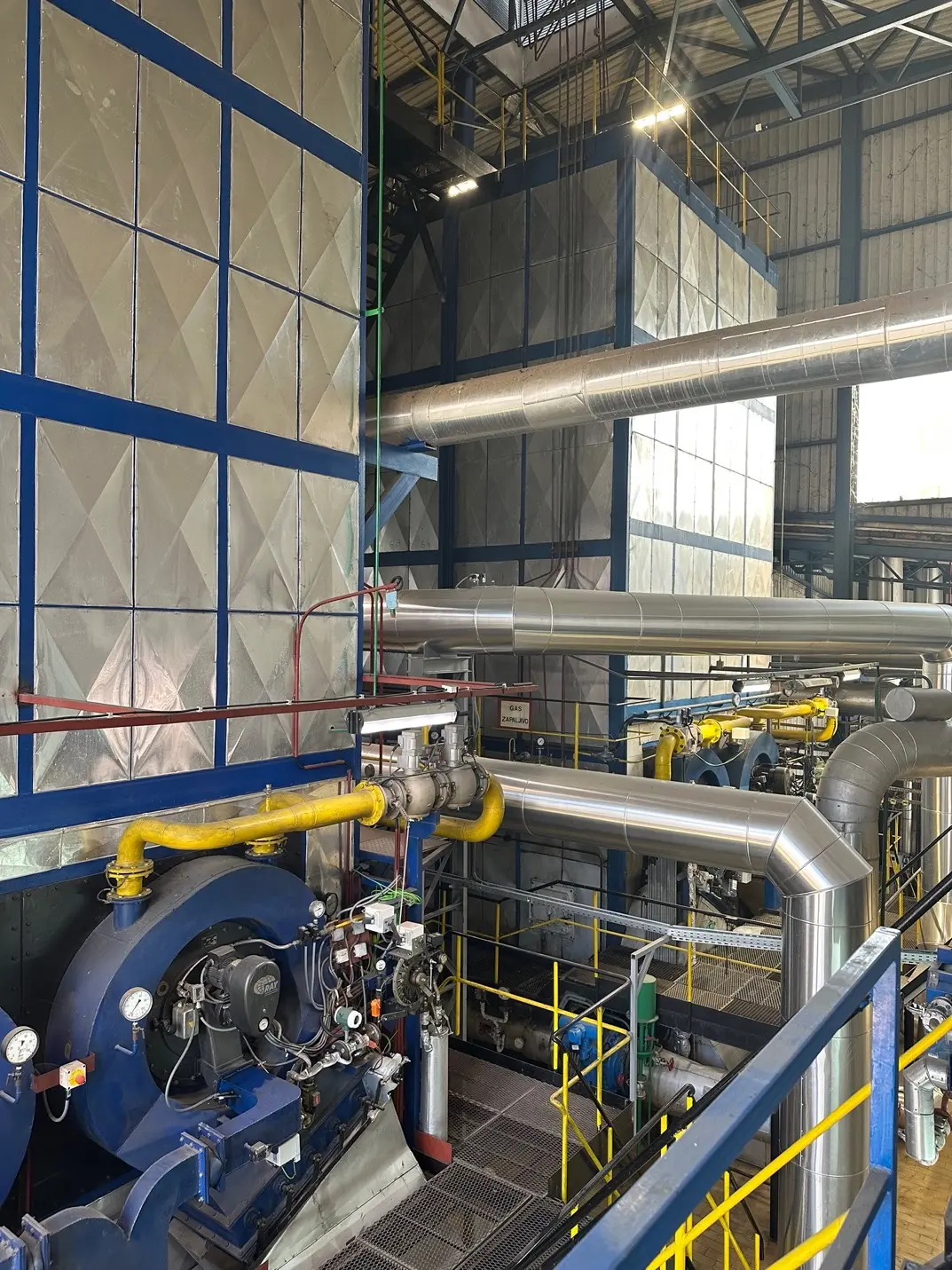
Toplana Mirijevo, owned and operated by JKP Beogradske Elektrane, runs two hot-water boilers rated at 58.15 MW and two steam boilers rated at 5 t/h. As an important node in Belgrade's district heating network, the reconstruction had to solve two problems at the same time: emissions and operating capacity.
Before work began, measured NOx emissions on the hot-water boilers ranged from 120 to 180 mg/m³, and from 140 to 180 mg/m³ on the steam boilers. New Serbian regulations (Decree 06/2016) set limits of 100 mg/m³ for hot-water boilers and 110 mg/m³ for steam boilers — putting the entire plant out of compliance. At the same time, the boilers were not reaching their rated output, meaning any reconstruction had to do more than just cut emissions.
MIK Projekt was engaged to design and deliver a complete reconstruction of all four boilers, covering combustion equipment, recirculation systems, pumps, pipework, mechanical installation, and commissioning.
Key result
NOx emissions were reduced from 120–180 mg/m³ (hot-water boilers) and 140–180 mg/m³ (steam boilers) to below the regulatory limits — below 100 mg/m³ and 110 mg/m³ respectively — bringing the entire plant into compliance with Decree 06/2016 without reducing rated thermal capacity.
Plant Baseline: What MIK Inherited
The Mirijevo boiler inventory before reconstruction comprised four units across two categories.
| Unit | Type | Manufacturer | Purpose | Rated capacity |
|---|---|---|---|---|
| VK1, VK2 | TE-350 | Minel, Belgrade | Hot-water district heating | 58.15 MW (max) / 11.60 MW (min) |
| PK1, PK2 | TE-106 | Minel, Belgrade | Process steam | 5 t/h / 3,3 MW |
Both boiler types ran on natural gas as primary fuel, with heavy fuel oil (mazut) as backup. The hot-water boilers operated at 19 bar working pressure (maximum permitted: 27 bar), with a supply/return temperature regime of 170/105 °C on gas and a rated efficiency of 91.5% on gas (91% on mazut). At maximum load, each TE-350 consumed 6,430 Nm³/h of natural gas or 5,640 kg/h of mazut. The steam boilers operated at 7 bar working overpressure, producing saturated steam at 194 °C with feed water at 105 °C.
The Combustion Problem Before Reconstruction
The original burners had no flue gas recirculation capability. Without FGR, peak flame temperatures in the furnace go unchecked, driving thermal NOx formation — the dominant NOx mechanism in gas-fired industrial burners. Measured emissions of 120–180 mg/m³ confirmed this: the plant was producing NOx at 20–80% above the new regulatory threshold.
Existing Air Supply Equipment
The fresh air fans for VK1 and VK2 were rated at 43,560 m³/h with a total pressure of 74.4 mbar and 110 kW motors. The original steam boiler fans delivered 9,792 m³/h at 44 mbar with 11 kW motors. Neither group was configured to support a recirculation circuit.
The steam boiler feed pumps were the existing "Tito Skopje" units: 110 l/min flow, 14 bar head, 11 kW motor — adequate for the original design, but without speed control.
The Engineering Approach: Two Boiler Types, Two Recirculation Architectures
The central engineering decision on this project was recognizing that the hot-water and steam boilers needed different recirculation strategies. Applying a single uniform solution to both types would have meant either over-engineering the steam circuit or under-performing on the hot-water boilers. MIK Projekt's engineering approach was to specify each system separately.
Hot-Water Boilers (VK1 and VK2): Integrated FGR with Dedicated Recirculation Fans
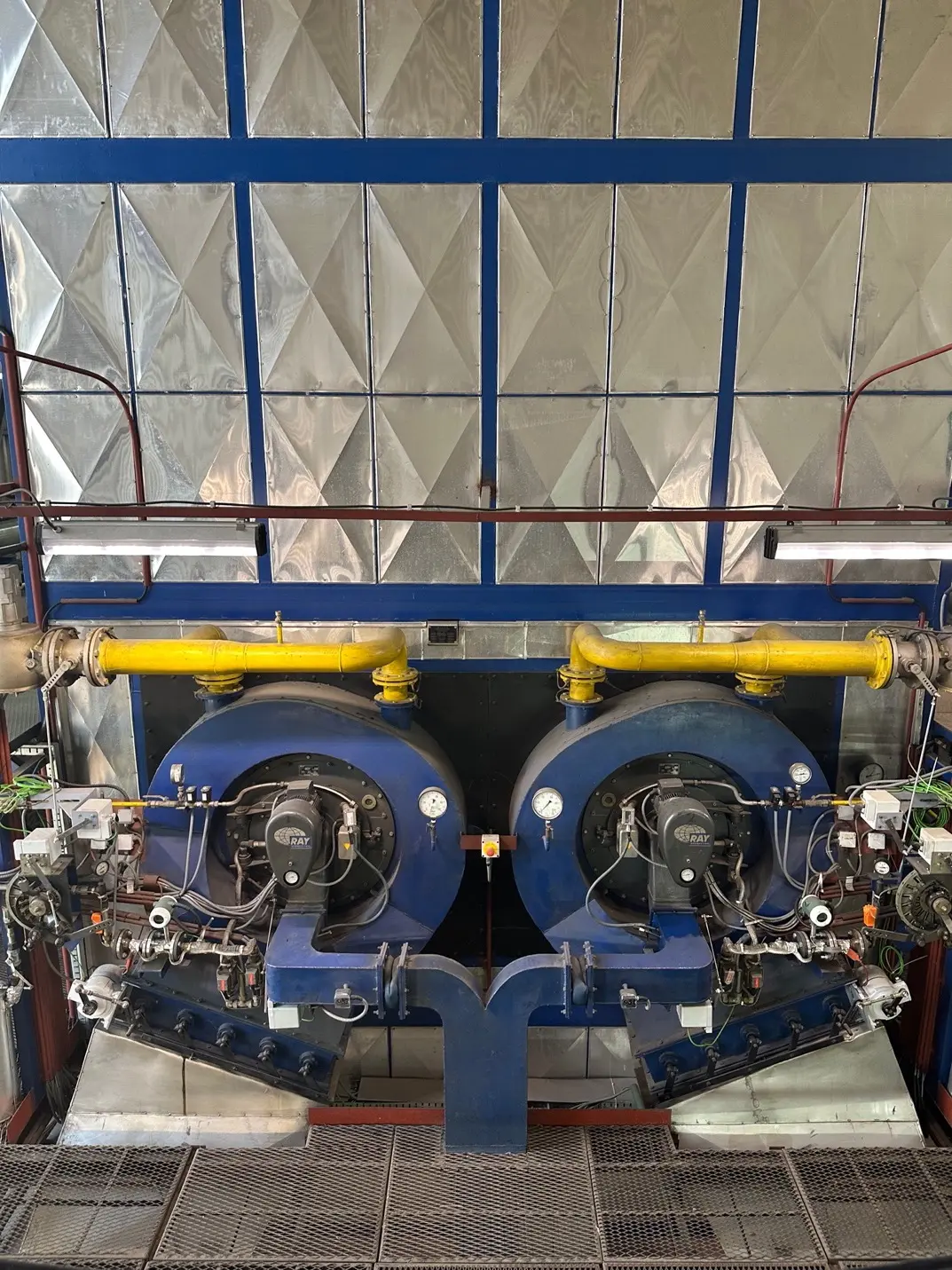
For the TE-350 units, MIK specified new Klima Celje industrial fans in order to achieve flue gas recirculation. Alongside each burner, a dedicated recirculation fan circuit was designed to return a controlled volume of cooled flue gas back into the combustion air stream. This dilutes the oxygen concentration at the flame front, lowers peak combustion temperatures, and suppresses thermal NOx formation at the source.
Recirculation fan specification (per boiler):
- Volumetric capacity: 18,000 m³/h
- Static pressure: 6,613 Pa at operating temperature of 180 °C
- Motor power: 55 kW
The design temperature of 180 °C for the recirculation fans is significant: it corresponds to the flue gas temperature at the outlet when running on gas, meaning the fans operate continuously at nominal conditions without thermal derating. The existing fresh air fans (43,560 m³/h, 74.4 mbar, 110 kW) were retained, with new variable frequency drives (VFDs) fitted to the 110 kW motors to enable load-matched combustion air control across the full range from 11.60 to 58.15 MW.
Steam Boilers (PK1 and PK2): Separate Recirculation Architecture
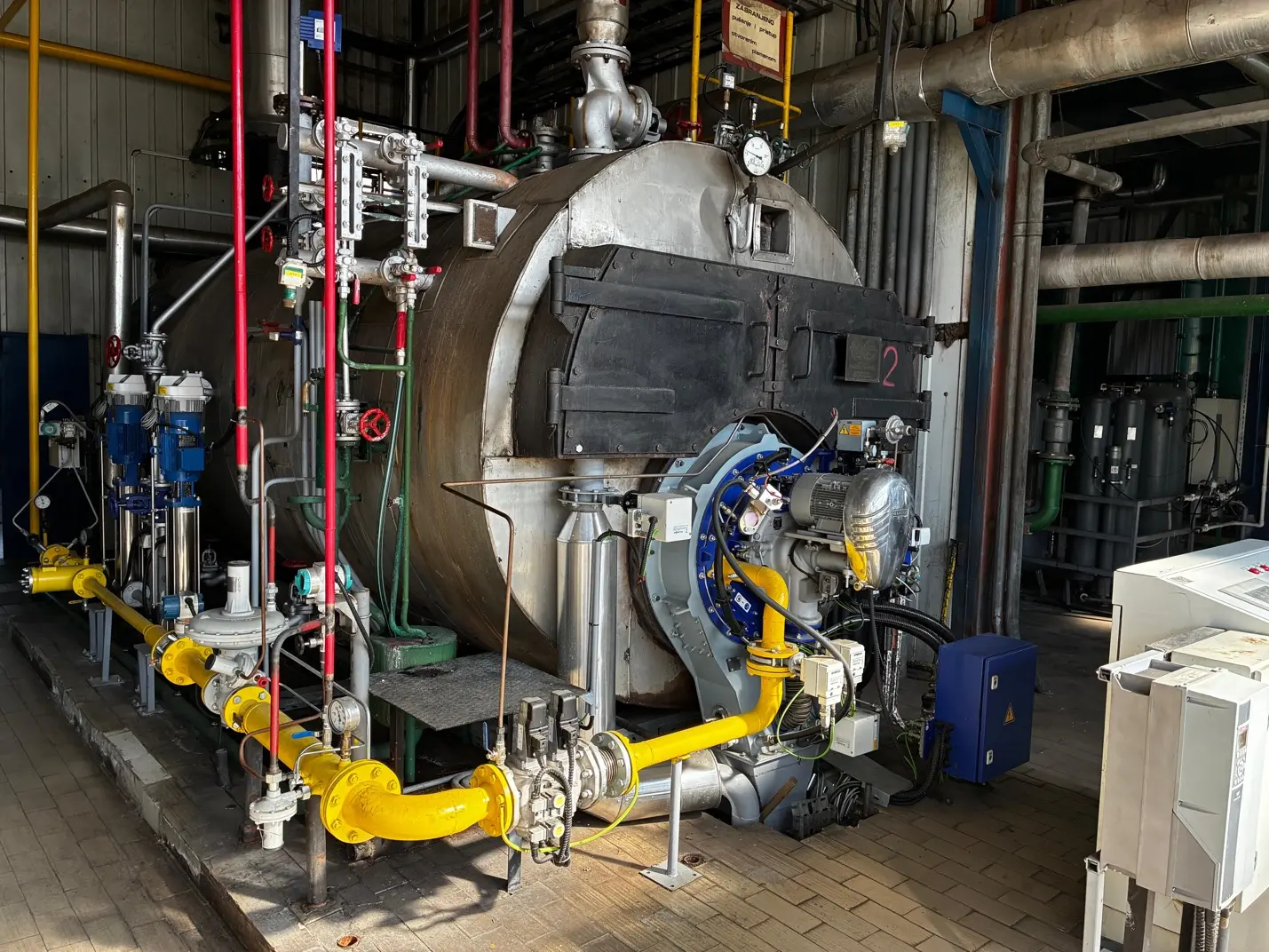
The TE-106 steam boilers presented a different set of constraints. At a rated output of 5 t/h and 3.3 MW thermal capacity, the furnace geometry and flue gas pressure drop characteristics differ substantially from the TE-350. Rather than integrating recirculation through the burner body, MIK designed a separate recirculation circuit with purpose-selected fans.
New steam boiler fan specification (Klima Celje, per boiler):
| Parameter | Old fan | New fan (Klima Celje) |
|---|---|---|
| Volumetric capacity | 9.792 m³/h | 4.320 m³/h |
| Static pressure | 44 mbar | 6.000 Pa (61,2 mbar) |
| Motor power | 11 kW | 15 kW |
The reduction in volumetric capacity from 9,792 to 4,320 m³/h is deliberate and technically justified: the new SAACKE burners operate with a more precise air-to-fuel ratio than the original equipment, requiring less total airflow for the same or better combustion result. The higher static pressure capability (6,000 Pa) compensates for the additional resistance introduced by the recirculation circuit. The modest increase in motor power (from 11 to 15 kW) reflects this pressure requirement.
New SAACKE burners were fitted to PK1 and PK2, with gas inlet pressure at the burners of 2.5 bar — matched to the plant's existing gas infrastructure.
Why Two Architectures Instead of One
The decision to design separate solutions rather than apply a single burner-fan package across all four boilers reflects the core of MIK Projekt's engineering approach on this project. A uniform solution would have been simpler to procure and install. It would also have been wrong: the TE-350 and TE-106 have different furnace volumes, different flue gas outlet temperatures, and different load control requirements. Forcing the same recirculation geometry onto both types would have introduced either excess pressure drop on the steam boilers or insufficient recirculation rate on the hot-water units.
The differentiated approach added engineering complexity upfront. It protected plant performance on both boiler types at commissioning and throughout the equipment's service life.
Execution: Phasing and Trial Run Protocol
One constraint shaped the entire project schedule: the mandatory Belgrade heating season runs from October 1 to May 3. The plant cannot be taken offline during those months.
The total project duration — design, equipment delivery, installation, and commissioning — was set at 210 effective days. That deadline dictated a strict phasing approach:
- Off-season works: major mechanical installations including recirculation ducts, new fan assemblies, and BMS cabinets were completed outside the heating season
- On-season commissioning: the final trial run required the plant to be under real load, which meant it had to take place during the heating season
Trial Run Protocol
The project specification mandates a continuous 7-day trial run under load before final acceptance:
| Day | Fuel | Purpose |
|---|---|---|
| Days 1–6 | Natural gas | Prove 15% recirculation rate and NOx below 100 mg/m³ |
| Day 7 | Mazut (heavy fuel oil) | Confirm backup fuel readiness and dual-fuel compliance |
This is not a formality. Seven continuous days under real thermal load is the only way to verify that recirculation performance stays stable across the full operating range — not just at a single test point.
Complete Scope of Works
MIK Projekt delivered the reconstruction as a complete EPC engagement. The scope covered combustion, mechanical, and control systems across all four boilers.
Combustion and Recirculation Systems
- Supply and installation of new SAACKE burners on PK1 and PK2
- Design and installation of dedicated flue gas recirculation fan systems on VK1 and VK2 (18,000 m³/h, 55 kW per unit)
- Design and installation of separate recirculation fan systems on PK1 and PK2 (Klima Celje, 4,320 m³/h, 15 kW per unit)
- Recirculation pipework, dampers, and connecting ducts on all four boilers
- Retention and integration of existing fresh air fans (VK1/VK2) with new VFD control
Pump and Auxiliary Systems
- Replacement of existing "Tito Skopje" feed pumps on steam boilers with new Lowara 5SVH23F040T/4 units (DN32 PN16), complete with variable frequency drives
- Associated pipework, valves, and mechanical connections
Burner Management and Controls
- Installation of new burner management systems (BMS) on all four boilers, replacing the legacy control logic
- Integration of VFDs on the 110 kW fresh air fan motors (VK1/VK2) with the new BMS for load-matched combustion air modulation
- Integration of VFDs on the new Lowara feed pumps (PK1/PK2) with the BMS for feed water flow control
Installed Equipment Summary
| Equipment | Specification | Qty |
|---|---|---|
| SAACKE burners | Gas/mazut, low-NOx with FGR | 2 |
| FGR fans (hot-water boilers) | 18.000 m³/h, 6.613 Pa, 55 kW | 2 |
| Combustion fans (steam boilers) | 4.320 m³/h, 6.000 Pa, 15 kW (Klima Celje) | 2 |
| Feed pumps (steam boilers) | Lowara 5SVH23F040T/4, DN32 PN16 + VFD | 2 |
| Burner management systems | New BMS with VFD integration | 4 |
| Variable frequency drives | 110 kW (fresh air fans, VK) | 2 |
Before and After: How the Boiler Room Actually Works Now
The most visible change at Mirijevo is the emissions number. The less visible change is how the plant operates.
Legacy Control Logic (Before Reconstruction)
The original VK1 and VK2 burners used mechanical linkages — physical rods connecting the air dampers to the gas valves. Air-to-fuel ratios were set by manually adjusting these rods. The LEC 1 controllers managing the older burners had no ability to respond dynamically to changing load conditions. If the boiler was running at 40% load, the combustion system was still configured for a fixed point somewhere in the middle of its range.
The result was predictable: combustion efficiency dropped at partial load, excess air increased stack losses, and NOx control was difficult because flame temperatures were not actively managed.
Modernized Control Logic (After Reconstruction)
The new BMS replaces mechanical linkages with independent, fail-safe servomotors at every control point: gas valve, primary air damper, secondary air damper, and the new recirculation gas damper. Each actuator responds to the BMS independently, meaning the system can continuously optimize the air-fuel-recirculation mix rather than holding a fixed mechanical position.
Key improvements in practice:
- O2 trim control: the BMS continuously monitors stack oxygen content and makes real-time micro-adjustments to the fuel-air ratio. Instead of running at a fixed excess air setting, the system automatically finds the optimal point for each load condition
- VFD fan control: the 110 kW fresh air fans now run on low-harmonic variable frequency drives. Rather than throttling airflow with dampers (which wastes motor energy), the system adjusts actual motor speed based on differential pressure between the fan discharge and the furnace. At partial load, the fans slow down — significantly reducing electrical consumption
- Dual-burner safety logic: each 58.15 MW boiler has two burners. The new logic treats them as a single integrated system. If one burner trips, the other automatically modulates to minimum load to maintain furnace stability, rather than triggering a full plant shutdown. For a district heating plant serving a live network, avoiding unnecessary outages is a direct operational benefit
The shift in control philosophy: the old system was set once and left. The new system continuously adapts. That difference matters more over an entire heating season than any single performance data point.
Results: Measured Outcomes After Reconstruction
Post-commissioning performance at Mirijevo can be assessed across three dimensions: emissions compliance, thermal capacity, and operational control.
NOx Emissions: From Non-Compliance to Below the Regulatory Threshold
| Measurement point | Hot-water boilers (VK1/VK2) | Steam boilers (PK1/PK2) |
|---|---|---|
| Before reconstruction (measured range) | 120–180 mg/m³ | 140–180 mg/m³ |
| After reconstruction (measured) | Below 100 mg/m³ | Below 110 mg/m³ |
| Regulatory limit (Decree 06/2016) | 100 mg/m³ | 110 mg/m³ |
The reduction represents a minimum 44% drop from the lower end of the pre-reconstruction range, and up to 67% from peak measured values. The plant now operates with a compliance margin below the 100 mg/m³ threshold, providing headroom against measurement variability and future regulatory tightening.
This was achieved through combustion modification alone — no post-combustion flue gas treatment (SCR, SNCR) was required. FGR reduces NOx formation at the source by lowering peak flame temperature, which is both technically cleaner and operationally simpler than exhaust-side treatment systems.
Thermal Capacity: Rated Output Protected
The TE-350 hot-water boilers now operate across their full design range:
| Parameter | Value |
|---|---|
| Maximum thermal output | 58,15 MW |
| Minimum thermal output | 11,60 MW |
| Turndown ratio | ~5:1 |
| Working pressure | 19 bar |
| Supply/return temperature (gas) | 170/105 °C |
| Maximum water flow (gas) | 509 t/h |
VFD-controlled combustion air fans enable precise air-to-fuel modulation across this entire range, which is especially important at low load: without VFD control, excess air at partial load increases stack losses and can destabilize FGR performance.
Operational and Control Improvements
The new BMS installations across all four boilers replaced outdated control logic with modern, integrated burner management. Key operational benefits:
- Automated combustion optimization: the BMS continuously adjusts the air-fuel ratio to match load demand, reducing manual intervention and operator-dependent combustion quality variability
- VFD integration on air fans: eliminates fixed-speed fan operation, reduces electrical consumption at partial load, and enables the precise airflow modulation that FGR requires
- VFD-controlled feed pumps (steam boilers): Lowara units with VFDs replace fixed-flow pumps, allowing feed water delivery to track steam demand rather than running at constant speed regardless of boiler load
- Retained dual-fuel capability: SAACKE burners maintain gas/mazut dual-fuel operation, preserving fuel supply security for the district heating network
What This Means for District Heating Operators
Mirijevo is a good example of the pressure district heating plants across Serbia and the region are under. Older boilers may be structurally sound, but when emissions regulations tighten, the combustion system becomes the weak point.
Regulatory Compliance: Decree 06/2016
The primary driver of this project was Serbian Decree 06/2016, which set new NOx emission limits for combustion plants:
| Boiler type | Permitted NOx limit |
|---|---|
| Hot-water boilers | Below 100 mg/m³ |
| Steam boilers | Below 110 mg/m³ |
At 120–180 mg/m³ before reconstruction, Toplana Mirijevo was operating above both thresholds. Non-compliance carries real consequences: environmental penalties and, ultimately, the risk of forced shutdown for a plant serving a significant portion of Belgrade's district heating network.
Lifecycle and Reliability: What the New Equipment Actually Delivers
This is not just a matter of passing an emissions test. The modernization delivers measurable reliability improvements over the plant's service life:
- 10-year spare parts guarantee on the new equipment — operators know replacement components will be available without procurement risk
- VFD soft-start and flying start on the 110 kW fan motors eliminates the mechanical shock of direct-on-line starting, which degrades motor insulation and bearing life over time. Soft-starting alone can significantly extend motor service intervals
- SIL 3 safety integrity on the new BMS electronics, certified to EN 61508 — the automated safety chains for gas leak, flame failure, and low water level are substantially more reliable than the 1980s relay logic they replaced
Reconstruction vs. Full Replacement
For operators, the practical question is not whether to modernize, but how to do it without losing output or taking a longer outage than necessary.
| Option | What it means | Trade-off |
|---|---|---|
| Full boiler replacement | Replace the entire vessel | Highest cost, longer outage, loss of existing vessel value |
| Reconstruction with FGR | Keep the pressure vessel, modernize combustion and controls | Lower disruption, lower capital impact, preserves rated output |
MIK Projekt took the reconstruction route at Mirijevo, but not with a one-size-fits-all approach. The hot-water and steam boilers needed different recirculation layouts because their furnaces, flue gas paths, and operating conditions are not the same. That differentiation is what protected performance on both boiler types.
The real value of the project is not the equipment list. MIK designed a reconstruction that brought the plant into compliance, protected output, extended the useful life of the existing boilers, and left the operator with a control system that will run reliably for the next decade — drawing on its own manufacturing capability for non-standard components and systems.
Conclusion
MIK Projekt reconstructed Toplana Mirijevo by solving the two problems that mattered most: emissions compliance and operating performance. The result was not a cosmetic upgrade. It was a targeted engineering intervention that brought NOx below the new limit, protected rated capacity, and kept the existing boiler vessels in service.
The project demonstrates the kind of value MIK brings to similar plants. The company did not treat all four boilers the same and did not impose a generic solution on different equipment types. It selected different recirculation architectures for the hot-water and steam boilers, matched them with new burners, pumps, fans, pipework, and BMS controls, and delivered a plant that is better aligned with current operating requirements.
For district heating operators, the lesson is straightforward. If the pressure vessel is still sound, a well-engineered reconstruction can be the smarter move over full replacement. It can cut emissions, preserve capacity, and extend plant life without unnecessary downtime.
Need to modernize an existing boiler plant without sacrificing output?
MIK Projekt designs and delivers combustion and thermal energy reconstructions for district heating systems, industrial boilers, and energy plants across Serbia and the region. Contact us to discuss your plant, your emissions target, and the most efficient path to compliance.
Frequently asked questions
What did MIK Projekt do at the Mirijevo district heating plant?
MIK Projekt replaced the burners on two steam boilers (PK1 and PK2), added flue gas recirculation systems on all four boilers, installed new pumps, fans, pipework, and burner management systems, and commissioned the complete plant. The works covered two 58.15 MW hot-water boilers and two 5 t/h steam boilers.
What problem was the reconstruction solving?
The plant had two issues: NOx emissions above the new regulatory limit and boilers not reaching their rated output. The reconstruction had to fix both without taking the plant offline longer than necessary.
How were NOx emissions reduced?
By installing new SAACKE low-NOx burners with flue gas recirculation. FGR works by returning a portion of cooled flue gas into the combustion air stream, which lowers peak flame temperature and suppresses NOx formation at the source. No post-combustion treatment was required.
Why were two different recirculation solutions used?
The hot-water and steam boilers have different furnace geometries, flue gas paths, and operating pressures. Applying the same solution to both types would have compromised performance on one or both. MIK Projekt engineered each recirculation circuit to match the specific boiler type.
What were the results after reconstruction?
NOx emissions dropped from 120–180 mg/m³ to below 100 mg/m³ on the hot-water boilers, and from 140–180 mg/m³ to below 110 mg/m³ on the steam boilers — bringing the plant into full compliance with Decree 06/2016. The hot-water boilers now operate across their full rated range of 11.60 to 58.15 MW, and all four boilers have new burner management systems for automated combustion control.