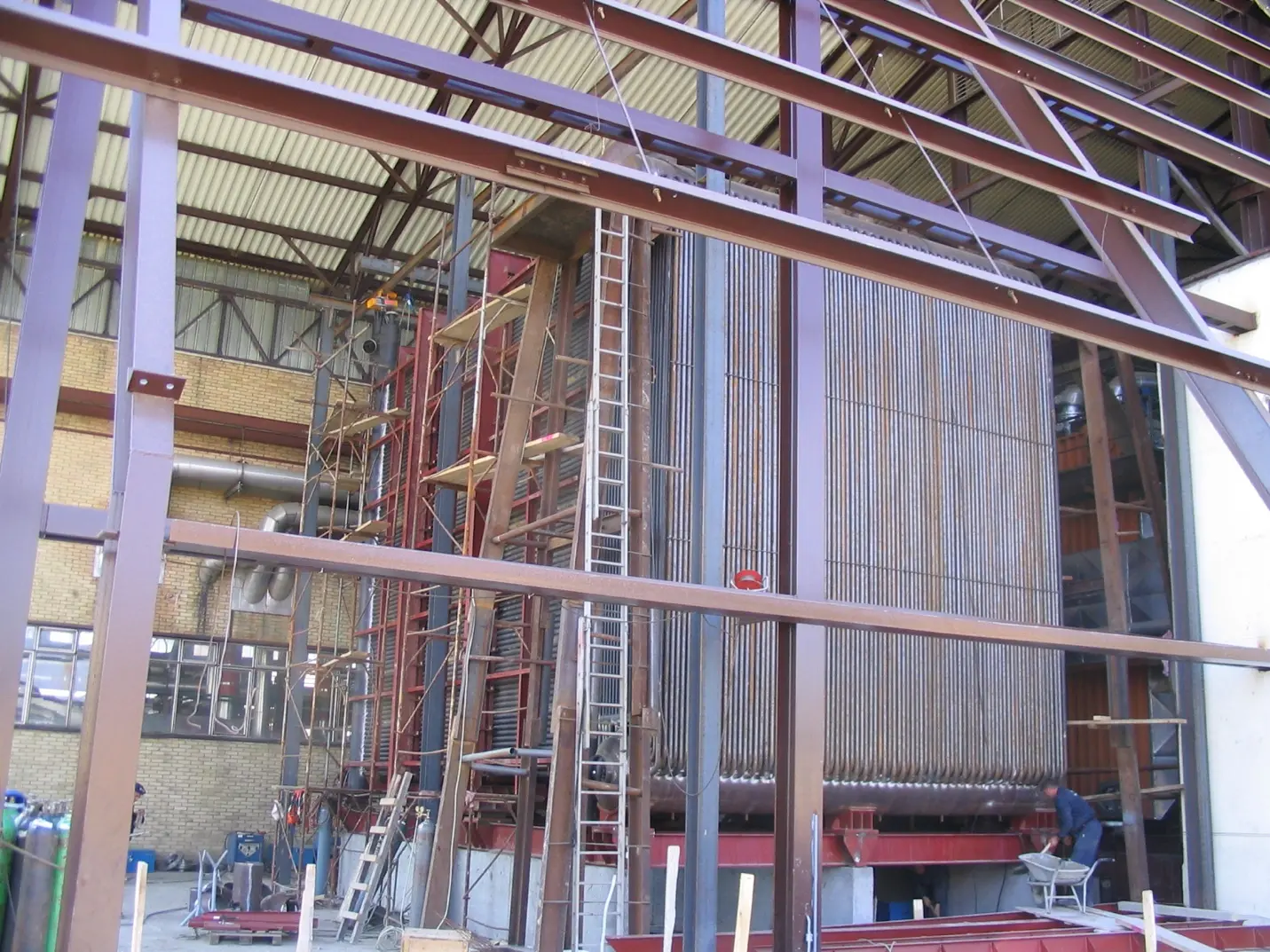
In 2007, MIK Projekt completed the most demanding single-unit hot water boiler project in its history: a 140 MWth natural-gas-fired boiler installed at District Heating Plant Zapad in Novi Sad. Nearly two decades later, the unit remains in continuous operation and holds a distinction that has not been surpassed — it is still the largest hot water boiler in Serbia.
This is not a story about a product delivered and forgotten. It is a record of what engineering at full scale looks like: the decisions made under real constraints, the hydraulic solutions required to move heat at this volume, and the performance figures that have held up across years of base-load operation in one of Serbia's most important district heating networks.
Key facts at a glance
| Parameter | Value |
|---|---|
| Rated thermal output | 140 MW |
| Fuel | Natural gas |
| Working pressure | 12 bar |
| Inlet / outlet temperature | 70°C / 150°C (ΔT = 80°C) |
| Thermal efficiency (without recirculation) | 97.4% |
| Total design volume flow | 1,488 t/h (two parallel circuits, 744 t/h each) |
| Combustion system | 2 × SAACKE burners |
| Location | District Heating Plant Zapad, Novi Sad, Serbia |
| Year of commissioning | 2007 |
| EPC scope | MIK Projekt (engineering, construction, commissioning) |
The Zapad Plant and Novi Sad's District Heating Network
Novi Sad operates one of Serbia's most developed district heating systems. By the time the Zapad boiler was commissioned, the city's network already spanned hundreds of kilometres of distribution pipework and thousands of substations, supplying heat to a large portion of the urban population. The total installed heat-generating capacity at heat-only boiler plants in Novi Sad stood at approximately 640 MWth in 2007, meaning the single unit MIK Projekt delivered at Zapad represented roughly 22% of that installed base.
A base-load role in a high-demand network
District Heating Plant Zapad serves the western residential and mixed-use districts of Novi Sad. In a network of this scale, base-load boilers are the backbone of heat supply: they run at or near full output through the heating season, absorbing the sustained demand that peaking units cannot economically cover. A 140 MW single unit in this role is not a margin asset — it is the primary heat source for a significant portion of the city.
The technical demands that follow from this role are straightforward but unforgiving: stable outlet temperatures under variable load, sustained efficiency across the operating range, and the reliability that base-load service in a large urban network requires.
The Novi Sad district heating system has reported production efficiency figures of approximately 95–96% in recent years, with overall system efficiency (generation through distribution) at around 85%. Against that backdrop, the 97.4% thermal efficiency achieved by the Zapad boiler without recirculation represents a meaningful margin above the network average, and above the Serbian national average plant efficiency of 91–94% recorded in peer-reviewed assessments of the sector.
Thermal Performance: What 97.4% Efficiency Without Recirculation Means
The headline efficiency figure — 97.4% without recirculation — requires context to be properly understood.
In hot water boilers operating at high outlet temperatures, flue gas condensation on heat exchange surfaces is a persistent risk. When return water temperature is low, the flue gas can cool below its dew point, causing acidic condensate to form on the convective surfaces. The standard engineering response is to recirculate a portion of the hot outlet water back into the inlet circuit, raising inlet temperature enough to keep flue gas above dew point. It works, but at a cost: it reduces the effective temperature differential across the boiler and, with it, thermal efficiency. Most large hot water boilers at similar temperature regimes accept this trade-off as a matter of course.
The significance of operating without recirculation
At a 70°C inlet and 150°C outlet, the risk of flue gas condensation is real and must be managed through combustion system and heat exchange design rather than through hydraulic recirculation. Achieving 97.4% efficiency under these conditions means the boiler is extracting close to the maximum thermodynamically available heat from the fuel, while managing flue gas temperatures through design rather than through a hydraulic workaround.
For a 140 MW unit, the practical implication is significant. A 1% efficiency difference at this output represents approximately 1.4 MW of thermal energy — heat that would otherwise exit through the stack. Over a full heating season of continuous base-load operation, that margin translates directly into fuel savings and reduced operating cost for the plant.
Temperature regime and operating pressure
The 70°C / 150°C temperature regime places this boiler in the high-temperature hot water category, which demands more rigorous design than the lower-temperature systems common in smaller district heating applications. The 12 bar working pressure is consistent with the requirements of a high-temperature hot water circuit at these outlet conditions, providing the necessary margin above the saturation pressure of water at 150°C (approximately 4.76 bar absolute) to prevent steam formation within the boiler and the primary distribution circuit.
This combination of high outlet temperature, elevated working pressure, and large thermal output defines the engineering envelope within which MIK Projekt had to work — and within which the 97.4% efficiency figure was achieved.
Hydraulic Design: Two Parallel Water Circuits
At 140 MW output with an 80°C temperature differential, the required volume flow through the boiler is substantial. Applying the standard heat transfer relationship:
Q = ṁ × cp × ΔT
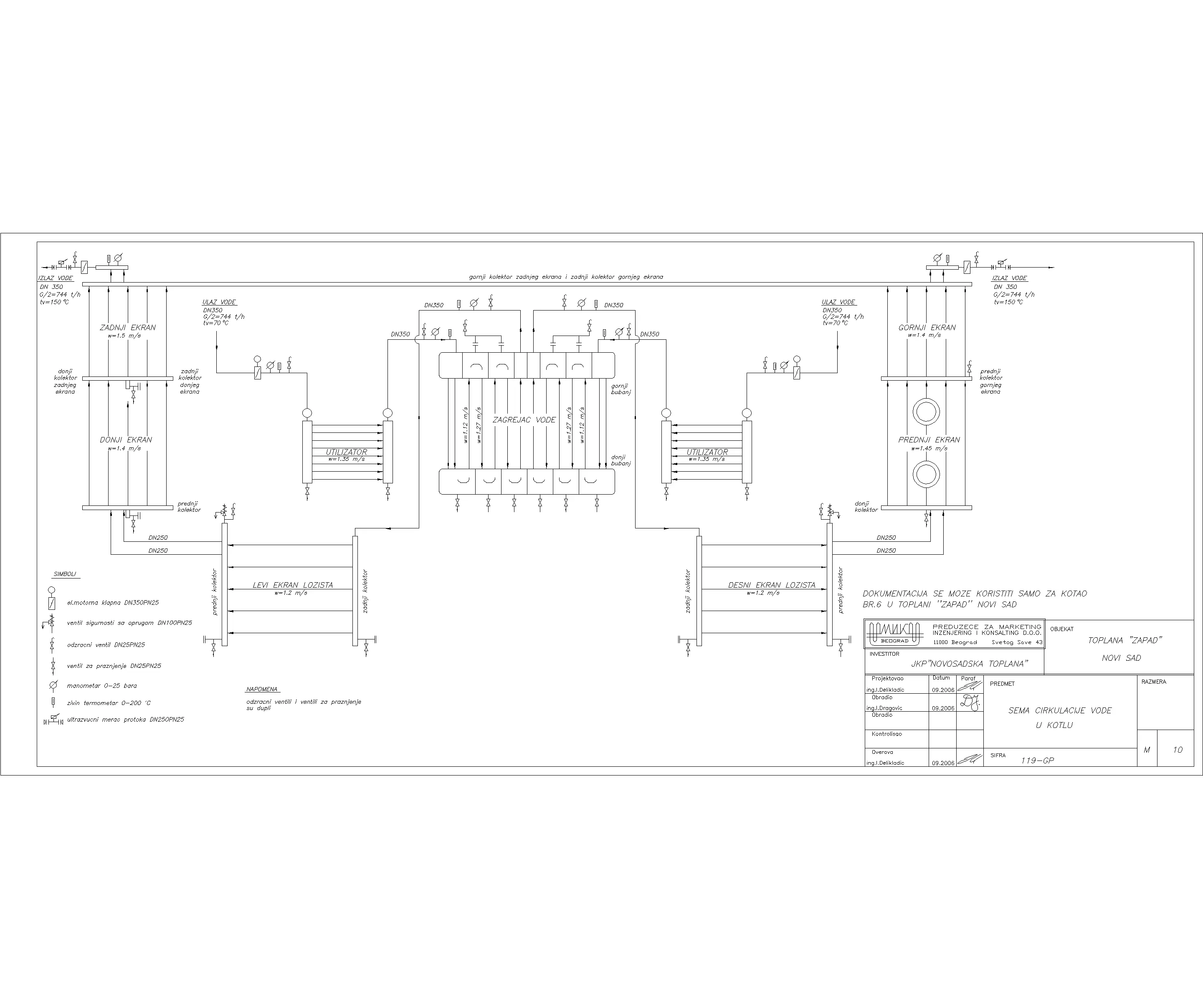
Where Q = 140,000 kW, cp (water) ≈ 4.186 kJ/kg·°C, and ΔT = 80°C, the required mass flow is approximately 418 kg/s, or roughly 1,505 t/h. The design figure of 1,488 t/h (two circuits at 744 t/h each) aligns precisely with this calculation, confirming the hydraulic sizing against the rated thermal output.
Why two parallel circuits
Moving 1,488 t/h of hot water through a single flow path at 12 bar would require either an exceptionally large-diameter pressure vessel or flow velocities that generate unacceptable pressure drop and erosion risk on heat exchange surfaces. Neither option is a practical engineering solution at this scale.
The answer MIK Projekt applied was to split the hydraulic circuit into two parallel paths, each carrying 744 t/h. This approach achieves several objectives simultaneously:
- Pressure drop management: Halving the flow in each circuit reduces pressure drop through the heat exchange surfaces, keeping auxiliary pump energy consumption within acceptable bounds.
- Velocity control: Parallel flow paths allow water-side velocities to be maintained within the range that maximises convective heat transfer without causing erosion or flow-induced vibration.
- Redundancy and controllability: Two hydraulic circuits provide a degree of operational flexibility — load can be modulated by adjusting flow distribution between the circuits, and partial operation remains possible under maintenance conditions.
- Structural feasibility: Splitting the flow allows the boiler's pressure parts to be designed within manufacturable and transportable dimensions, a practical constraint that becomes decisive at this scale.
Volume flow in context
744 t/h per circuit is a significant hydraulic load by any standard. For reference, a 10 MW hot water boiler operating across the same ΔT would require approximately 107 t/h total flow. The Zapad boiler moves roughly 7 times that volume through each of its two circuits. The pipework, valves, isolation equipment, and circulation pumps associated with this flow rate are themselves major engineering elements, each sized and specified as part of MIK Projekt's EPC scope.
The two-circuit hydraulic arrangement is not a complexity added for its own sake. It is the direct engineering consequence of delivering 140 MW through a single boiler unit, and it reflects the kind of systems-level thinking that distinguishes large-scale EPC work from standard boiler supply.
Combustion System: Two SAACKE Burners
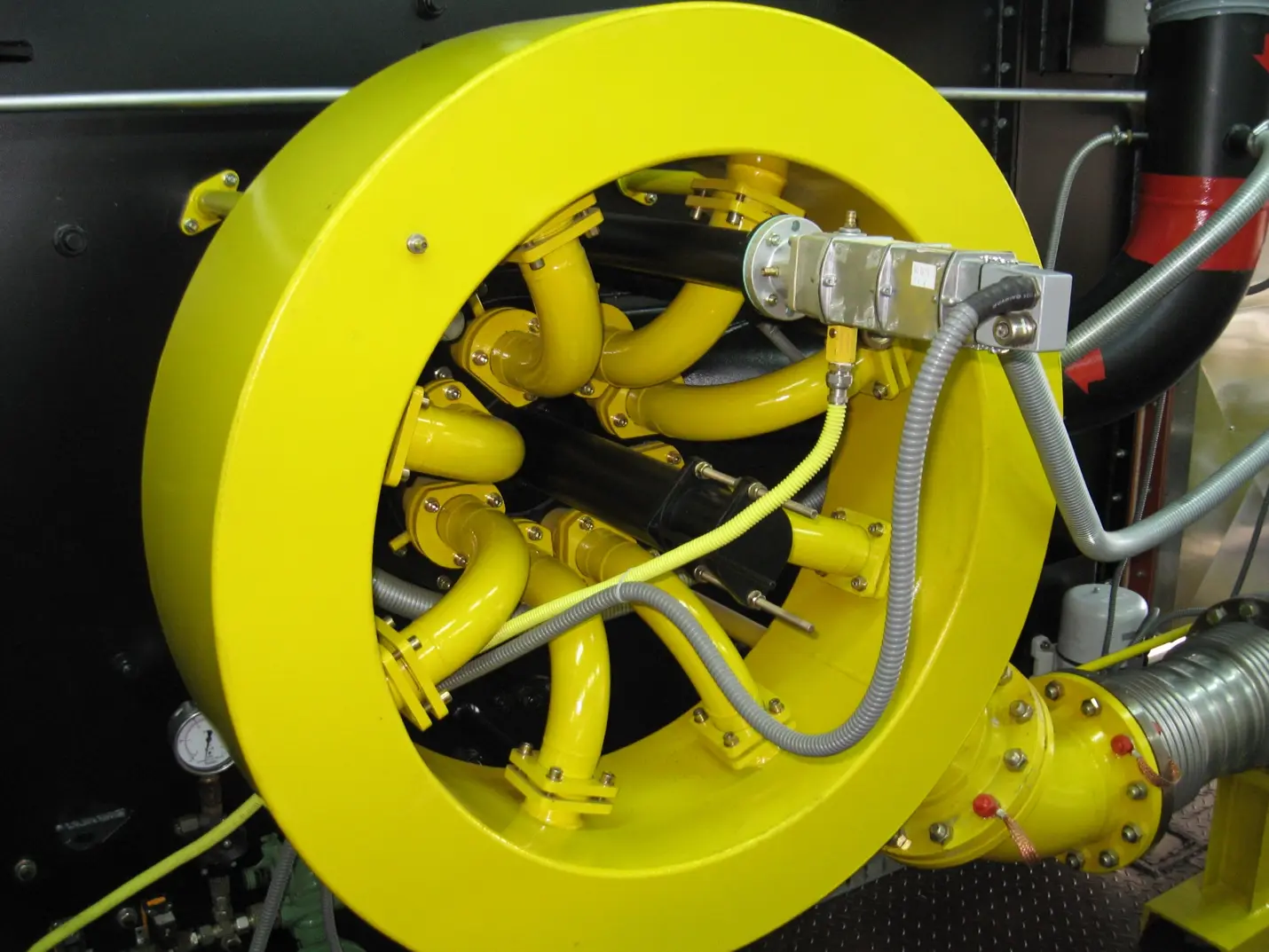
Firing 140 MW of thermal input through a single boiler requires a combustion system matched in scale and precision to the heat exchange design. MIK Projekt specified two SAACKE industrial burners for the Zapad unit, configured to fire the furnace volume at the rated output.
Why two burners at this scale
A single burner rated for 140 MW thermal input would present significant engineering challenges: flame geometry, furnace residence time, and heat flux distribution across the waterwall surfaces all become harder to optimise as burner size increases. Two burners allow the furnace heat release to be distributed more evenly, reducing peak heat flux at any single point on the pressure parts and giving greater flexibility in load modulation.
Two-burner arrangements at this scale also provide operational resilience. Should one burner require maintenance or experience a fault condition, the plant can continue operating at reduced output rather than facing a full unit shutdown.
SAACKE as the combustion partner
SAACKE industrial burners are specified for demanding applications where combustion stability, precise air-fuel ratio control, and long service intervals are non-negotiable requirements. For a boiler of this scale operating in continuous base-load service, those characteristics are not optional features — they are the baseline specification.
MIK Projekt's relationship with SAACKE as an authorized representative and service partner means the combustion system at Zapad was not simply procured and installed. It was integrated into the boiler design as a matched system, with the burner characteristics (flame shape, heat release rate, turndown capability) coordinated with the furnace geometry and the heat exchange surface layout. That level of integration is what allows the boiler to achieve 97.4% efficiency without recirculation: the combustion system is doing its part of the work precisely, not compensating for gaps elsewhere in the design.
| Parameter | Value |
|---|---|
| Number of burners | 2 |
| Burner manufacturer | SAACKE |
| Fuel | Natural gas |
| Firing configuration | Dual-burner, single furnace |
| Rated boiler thermal output | 140 MW |
Engineering and EPC Scope
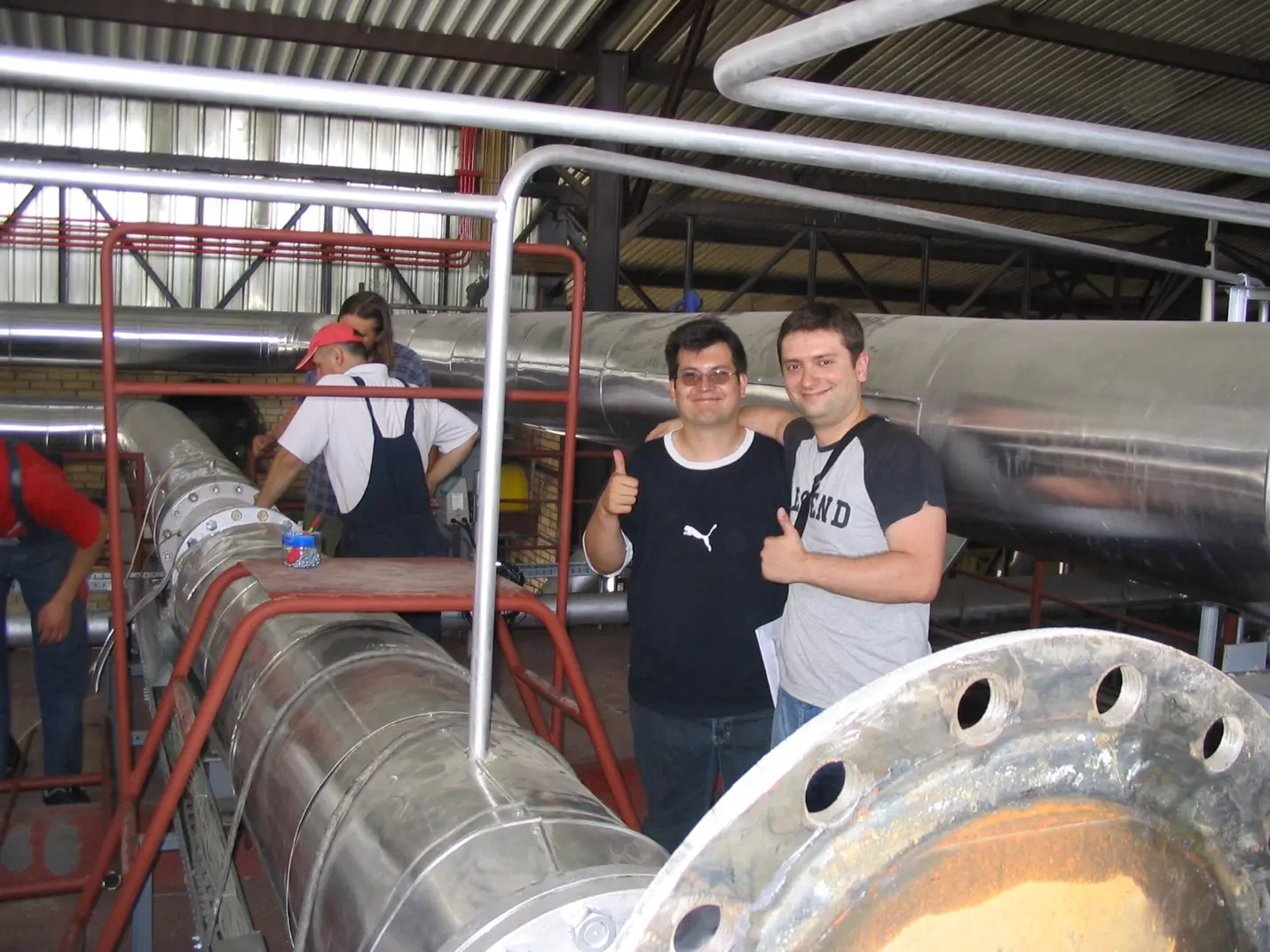
The Zapad boiler was not a procurement project. MIK Projekt carried full EPC responsibility: engineering, construction, and commissioning of the complete unit. That scope distinction matters, because it defines where the technical accountability sits.
From design to commissioning
At the engineering stage, the work encompassed thermal and hydraulic calculations to establish the heat exchange surface area, waterwall geometry, furnace volume, and the two-circuit hydraulic arrangement. The pressure parts were designed to meet the applicable pressure equipment standards, with the 12 bar working pressure and 150°C maximum outlet temperature defining the design envelope for the pressure vessel and associated pipework.
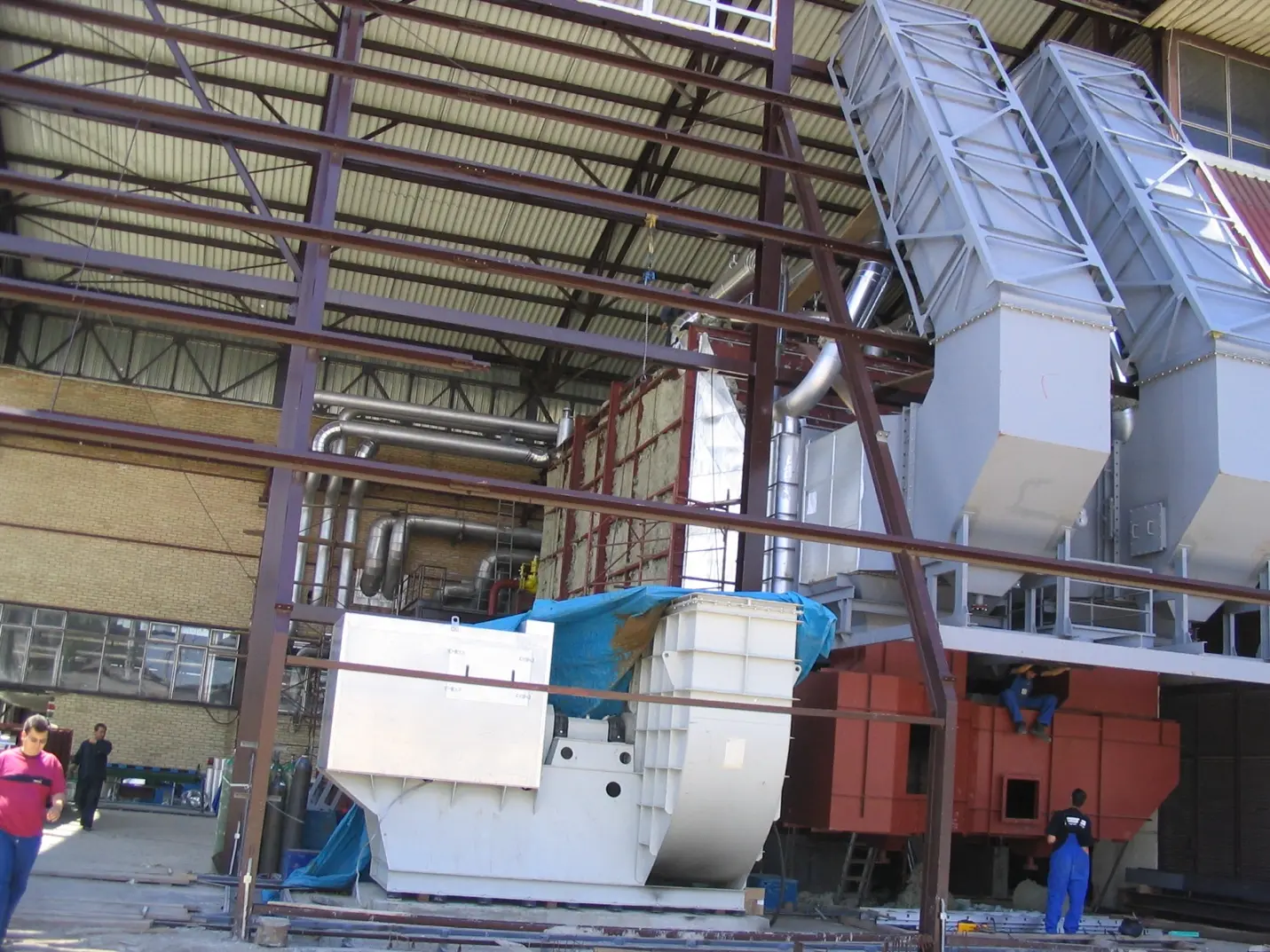
Construction included the manufacture and assembly of the boiler pressure parts, the integration of the two SAACKE burners into the furnace structure, and the installation of all associated mechanical, hydraulic, and control systems within the Zapad plant. At this scale, on-site construction and assembly work is substantial: the boiler structure, flue gas ducting, and the primary hydraulic connections to the plant's distribution network all form part of the scope.
Commissioning closed the loop. The unit was brought to operating conditions, the burners were set and tuned, and the hydraulic circuits were balanced to achieve the design flow distribution of 744 t/h per side. The 97.4% efficiency figure is a commissioning result — a measured performance value, not a design estimate.
What full EPC scope means in practice
The difference between supplying a boiler and delivering an EPC project at this scale is the difference between providing equipment and taking responsibility for a functioning system. MIK Projekt's scope at Zapad encompassed every element between the gas supply connection and the hot water outlet headers: the boiler itself, the combustion system, the hydraulic arrangement, the instrumentation and controls, and the verified performance on handover.
That is the standard against which the Zapad project should be read — not as a large equipment order, but as a complete engineering delivery at the upper limit of what a single hot water boiler unit can be asked to do.
A Reference That Has Not Been Surpassed
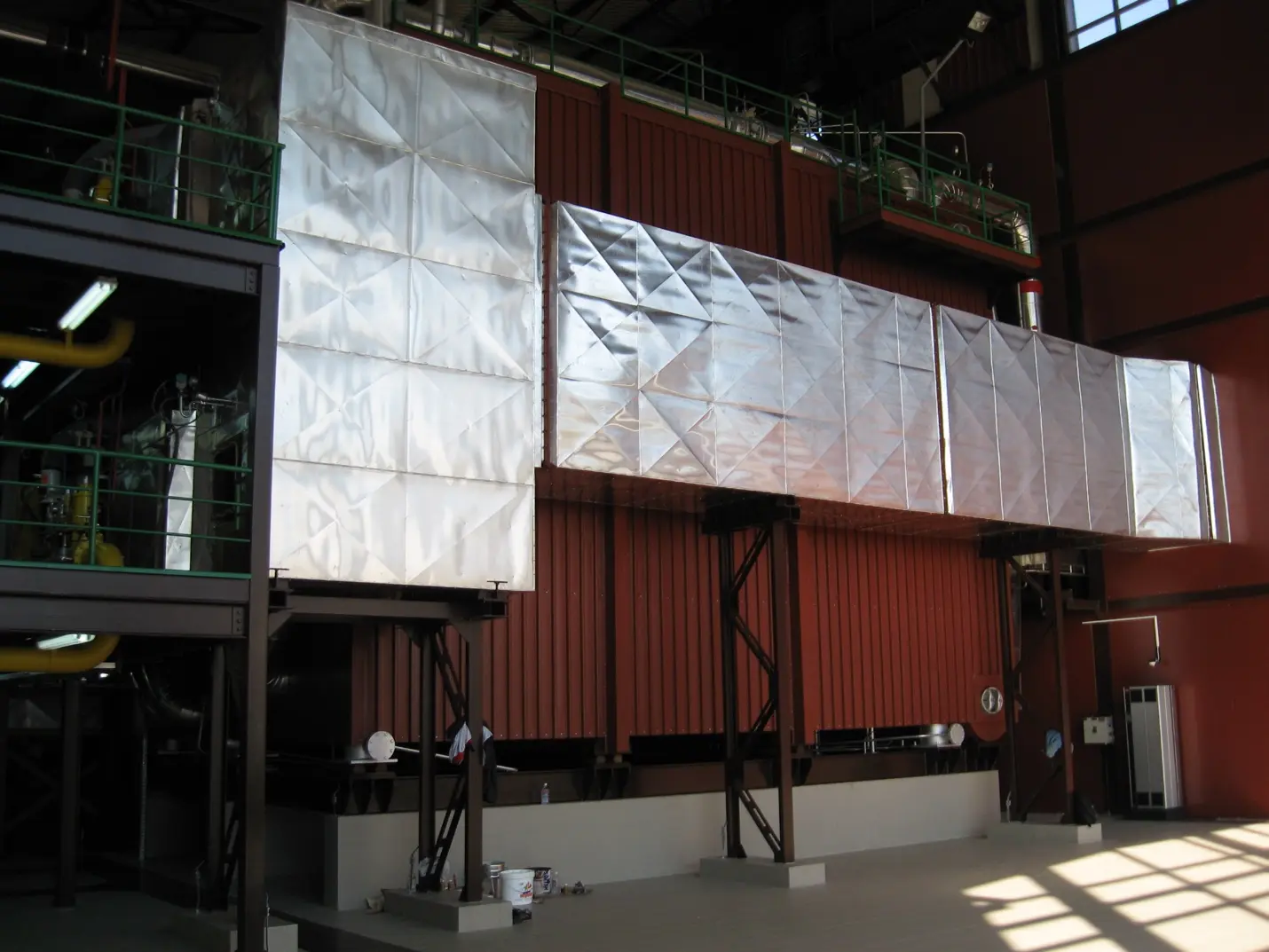
The Zapad boiler was commissioned in 2007. As of 2026, no single-unit hot water boiler of greater capacity has been installed in Serbia. That is not a claim based on marketing positioning — it is a verifiable fact about the engineering landscape of the Serbian district heating sector.
To understand why this matters, consider the context. Serbia's district heating infrastructure is substantial: total installed heat-generating capacity across the country stands at over 6,500 MWth, with natural gas powering approximately 75% of production. Within that installed base, the Zapad unit at 140 MW represents a scale that no domestic engineering project has since matched in a single hot water boiler unit.
Longevity as the real proof point
Engineering references age in one of two ways. Some are superseded quickly, rendered obsolete by advances in scale, efficiency, or technology. Others remain relevant because the engineering decisions behind them were sound enough to hold up over time.
The Zapad boiler falls into the second category. Nearly two decades of base-load operation in a high-demand district heating network is not a passive achievement. It reflects the quality of the original design, the integrity of the pressure parts, the reliability of the combustion system, and the competence of the EPC execution that brought all of those elements together as a functioning unit.
The 97.4% efficiency figure recorded at commissioning is the benchmark. It is the number against which the boiler's ongoing performance can be measured, and it is the number that defines what MIK Projekt delivered at Zapad. For a unit of this scale, achieving that figure without recirculation, and sustaining operation across nearly two decades, is the engineering record that the Zapad project leaves behind.
The Zapad boiler was built to serve a specific role in a specific network at a specific moment in the development of Serbian district heating infrastructure. It did that, and it continues to do it. Nearly two decades of uninterrupted base-load operation is not incidental — it is the result of engineering decisions made correctly the first time.
That is the legacy MIK Projekt engineered in 2007, and it is still standing.
Planning a large-scale boiler or district heating project?
MIK Projekt engineers, builds, and commissions hot water and steam boiler plants across Serbia and the region — from thermal and hydraulic design through combustion integration and commissioning. Contact us to discuss your capacity, efficiency target, and the most reliable path to delivery.
Frequently asked questions
What makes the Zapad boiler a legacy project for MIK Projekt?
It is MIK Projekt's largest single-unit boiler project and remains Serbia's largest hot water boiler. The unit was engineered, constructed, and commissioned in 2007 at District Heating Plant Zapad in Novi Sad, and it still operates as a reference point for large-scale thermal engineering.
What are the main technical specifications of the Zapad boiler?
The boiler is rated at 140 MWth, runs on natural gas, operates at 12 bar working pressure, and works across a 70°C inlet and 150°C outlet temperature regime. Its total design volume flow is 1,488 t/h, split across two parallel water circuits of 744 t/h each.
Why does the boiler use two parallel water circuits?
Two parallel circuits allow the large total flow to be handled with lower pressure drop, better velocity control, and more practical pressure-part sizing. At this scale, splitting the flow is the most workable way to maintain hydraulic performance without pushing the design into impractical dimensions.
What does 97.4% efficiency without recirculation mean?
It means the boiler achieves very high thermal performance without using a recirculation loop to raise inlet temperature and avoid condensation. That is important because recirculation can reduce the effective temperature differential and the useful heat extracted from the fuel.
Why are two SAACKE burners significant in this boiler design?
Two burners help distribute heat release more evenly across the furnace, improve load control, and support operational resilience. For a 140 MW hot water boiler, that combustion arrangement is part of the overall engineering needed to sustain stable, efficient operation.